Excavation is the controlled movement of earth removing, relocating, and reshaping soil and rock to prepare a site for construction, utility installation, drainage management, or other ground-level work. In Willis, Texas, and the broader northern Montgomery County area, excavation services are in consistent demand across residential construction, commercial development, rural property improvement, and infrastructure projects. The area’s distinctive soil conditions, its active pace of residential growth along the Lake Conroe corridor and the communities north of The Woodlands, and the mix of urban, suburban, and rural development all create diverse excavation needs. This guide explains what excavation services in Willis involve and why professional earthmoving expertise is foundational to so many ground-level projects.
What Is an Excavating Contractor?
An Excavating Service Willis contractor specializes in earthmoving the controlled removal, relocation, and management of soil, rock, and other subsurface materials to prepare a site for its intended use. Unlike general contractors who manage the full construction process, or specialized trades that focus on specific systems, excavating contractors focus on the ground itself: what condition it needs to be in, how it needs to be shaped, what must be removed, and what must be added or compacted to create a stable, properly draining foundation for whatever comes next.
Excavating contractors in Willis serve a broad range of clients. Residential property owners hire them for foundation excavation, pond and drainage installation, lot grading, and utility trenching. Developers rely on them for mass grading of new subdivisions, road preparation, and large-scale site work. Agricultural and rural landowners engage them for pond construction, drainage improvement, and access road work. Commercial developers need excavation for foundation preparation, parking lot sub-base, and utility infrastructure.
Core Excavation Services in the Willis Area
Foundation excavation is among the most critical applications of excavating services in Willis. Before any building foundation can be poured, the soil must be excavated to the correct depth and footprint, the subgrade must be prepared and compacted to the specified density, and any unsuitable material must be removed and replaced with engineered fill. In Willis’s expansive clay soil environment, this subgrade preparation is particularly important clay subgrades that are not properly prepared and protected can expand and contract under seasonal moisture changes, compromising foundation performance.
Utility trenching serves residential, commercial, and infrastructure projects throughout the Willis area. Water supply lines, sewer pipes, electrical conduits, gas lines, communication cables, and stormwater drainage pipes all travel underground, and their installation requires precise trenching to the specified depth, width, and alignment. Texas law requires notification through Texas 811 (Dig Safe) before any excavation begins, and excavating contractors must coordinate their work with utility locating services to avoid striking existing buried infrastructure.
Pond excavation is a particularly significant service in the Willis and Lake Conroe area. The region’s rural acreage properties support a strong tradition of farm ponds and recreational fishing ponds, and new pond construction or existing pond deepening and restoration are common project types for excavating contractors in Montgomery County. The area’s clay soils while challenging for construction are well-suited to pond construction because their low permeability provides natural water retention without requiring synthetic liners in many cases.
Drainage correction is one of the most frequent residential excavating service requests in the Willis area. The combination of flat topography, clay soils, and heavy rainfall creates persistent drainage challenges across the region. Excavating contractors install French drains, surface drainage swales, retention ditches, and outlet pipes to redirect water away from structures and off properties in a controlled manner.
Site rough grading the initial shaping of a cleared lot to the approximate design grades before fine grading and construction begin is the excavating service that sets the foundation for every subsequent step of a development project. Mass grading of large sites involves moving substantial volumes of soil from high areas (cuts) to low areas (fills) to create the design surface while minimizing unnecessary hauling of material off site.
The Soil Conditions That Shape Willis Excavation Work
Willis and the surrounding Montgomery County region sit on a distinctive soil substrate that significantly influences how excavation work is approached. The upper soil layers across much of this area consist of expansive clay a material that gains and loses volume with changes in moisture content. When wet, clay swells; when dry, it contracts and cracks. This behavior creates challenges for foundation engineering, drainage design, and subgrade preparation that excavating contractors must account for in their methods.
Clay soils are also relatively impermeable compared to sandy or gravelly soils. This low permeability means that water infiltrates slowly, making surface drainage management more important and making poorly graded or low-lying areas prone to ponding. Excavating projects in Willis typically incorporate drainage design considerations establishing grades, installing drain pipes, and creating drainage pathways rather than relying on soil infiltration to manage water.
In the foothill transition areas and the sandy soil zones north of Willis toward Walker County, soil conditions shift toward sandier material that is more permeable but may also be less stable as a foundation substrate. Excavating contractors familiar with the North Houston and Montgomery County region understand where these soil transitions occur and how to adjust their methods accordingly.
Excavation Equipment Used in Willis Projects
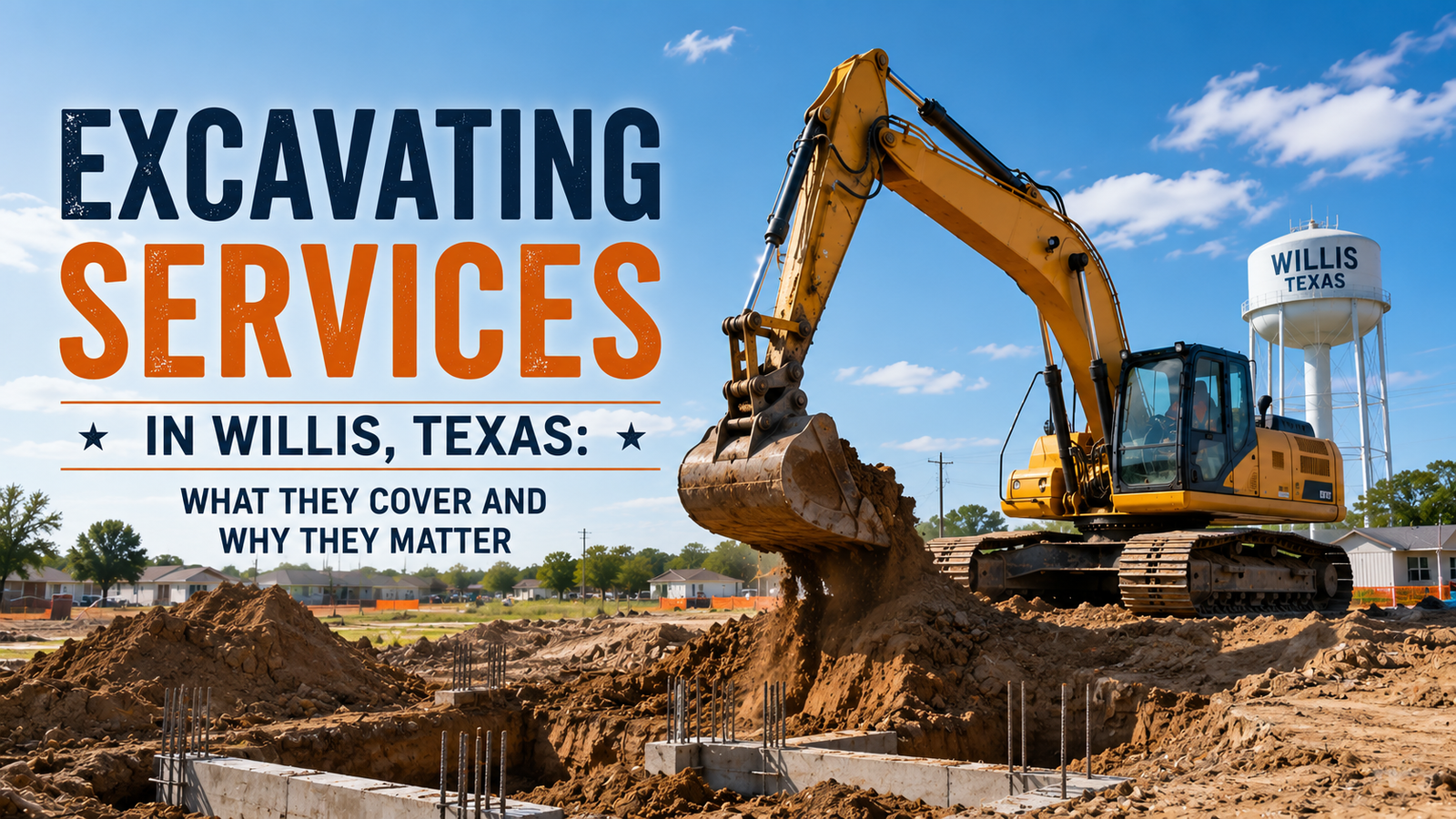
Tracked excavators are the primary tool for most Willis-area excavation work. Tracked machines as opposed to wheeled excavators provide better traction and stability on the clay and variable soil surfaces of Montgomery County and are less likely to become stuck in saturated conditions after rainfall events, which can halt wheeled equipment. Excavators in Willis range from compact mini-excavators (3 to 10 tons) for residential and tight-access applications to full-size machines (20 to 50 tons and above) for commercial and large-scale earthmoving.
Skid steers and compact track loaders serve material loading and site cleanup roles alongside excavators. Bulldozers and motor graders perform rough and finish grading on larger sites, pushing material across the surface to achieve specified contours. Dump trucks provide the hauling capacity to move excavated material off site when it cannot be reused, and to bring in imported fill, aggregate, or other materials when the site needs supplementation.
For utility trenching work, specialized trenching machines can achieve high productivity on straight trenching runs in consistent soil conditions. These are particularly useful for long utility line installations on cleared, accessible sites.
Regulatory Considerations for Excavation in Willis
Texas law requires that any person planning to excavate must contact Texas 811 at least two business days before digging begins. Texas 811 coordinates notification to underground utility operators, who send locators to mark the positions of buried utilities in the planned excavation area. This notification protects against strikes on buried utilities, which can cause dangerous outages, environmental incidents, and significant liability.
Grading and excavation that significantly alters drainage patterns may require permits from the City of Willis or Montgomery County. Projects in the floodplain of the San Jacinto River watershed, Lake Conroe, or other regulated waterways may additionally require coordination with the U.S. Army Corps of Engineers, TCEQ, or Harris-Galveston Coastal Subsidence District depending on the specific location and scope of work.
Common Questions About Excavating Services in Willis
What is the difference between excavation and grading? Excavation refers to the removal of earth below the existing surface. Grading refers to the shaping of the surface moving material horizontally to achieve specified elevations and slopes. In practice, these activities are closely linked: excavation generates the material that is then used in grading, and grading follows excavation to shape the disturbed area to the design surface.
How deep can residential excavation go in Willis without special requirements? Depth requirements depend on the project type. Utility trenches have OSHA-specified requirements for cave-in protection that become mandatory at depths of 5 feet or more. Foundation excavation depth depends on structural engineering specifications. Very deep excavations may require shoring design by a professional engineer.
Do Willis area excavating projects need to account for flooding? Yes. The Montgomery County and North Houston region has experienced significant flood events, and many parts of the Willis area are within or adjacent to mapped flood zones. Excavating contractors familiar with the region understand the drainage patterns, flood risk areas, and design requirements that influence how earthwork is planned and executed.